Why Spreadsheets Don't Work for Managing Travel Documents and Visas Across Countries
Spreadsheets break down when managing passports, visas, and travel requirements across countries. Learn why teams switch to structured systems for global travel operations.
Spreadsheets are the default tool for managing operations across industries. Professional sports teams use them to track riders and staff. Corporate teams rely on them for international travel coordination. Film and TV productions use them to manage crew logistics across shooting locations. Even leisure groups organizing complex trips often fall back on shared documents.
At a small scale, spreadsheets work. They're flexible, easy to set up, and universally understood.
The problem starts when travel becomes international, multi-country, and time-sensitive.
Managing passports, visas, and entry requirements across different countries is not just a data problem. It's a system problem. And spreadsheets, by design, are not systems.
The illusion of control
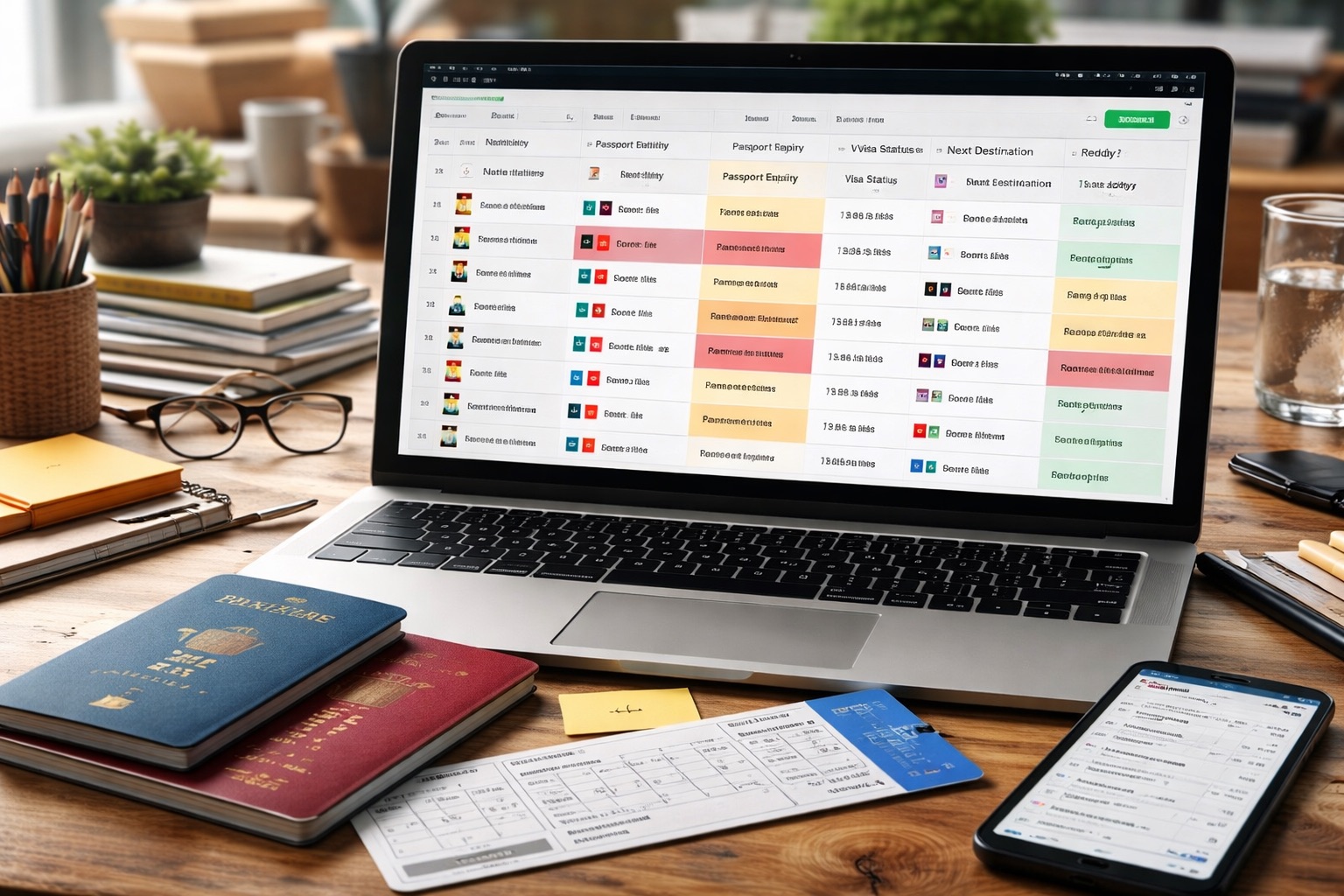
A spreadsheet gives the impression that everything is under control. Names are listed, passport expiry dates are filled in, and visa statuses are marked as complete or pending.
But what looks structured is often fragile.
A passport expiry date sitting in a cell does not tell you whether it meets the entry requirements of a specific country. A "visa: yes/no" column does not reflect processing timelines, changing regulations, or nationality-specific rules. A document marked as valid today may become a problem for a trip scheduled three weeks later.
Spreadsheets store information. They don't understand it.
As soon as travel involves multiple countries and different nationalities, the gap between stored data and actual readiness becomes significant.
Where things actually break
The failure of spreadsheets rarely comes from one obvious mistake. It comes from small gaps that compound over time.
A passport is renewed, but the new expiry date isn't updated. A visa requirement changes, but the spreadsheet still reflects the old rule. A new team member or crew member is added to a project, but their documents are not fully integrated into the system.
None of these issues are dramatic on their own. The problem is that spreadsheets don't surface them.
Errors remain invisible until they intersect with a real-world deadline. That's when they turn into operational issues: delayed travel, last-minute changes, or, in some cases, people simply being unable to enter the country.
This applies whether it's a cycling team traveling between races, a corporate team attending international events, or a film production moving crew between shooting locations.
Collaboration without ownership
As soon as multiple people are involved, spreadsheets introduce another layer of risk.
Shared documents make it easy for everyone to access information, but they don't define responsibility. Who is in charge of updating passport details? Who ensures visa requirements are accurate? Who validates that a team member is actually cleared to travel?
Without clear ownership, updates become inconsistent.
At the same time, collaboration itself creates friction. Multiple edits can overwrite information, formulas break without warning, and it becomes difficult to track what changed and why. When an issue is discovered, there is no reliable way to trace its origin.
The tool allows collaboration, but it does not structure it.
Static data in a dynamic environment
International travel requirements are not static. Entry rules change, visa processes vary by nationality, and document validity requirements depend on both destination and timing.
Spreadsheets, however, remain static unless someone actively updates them.
This creates a mismatch. The environment evolves, but the system used to manage it does not. Teams are forced into a reactive mode, manually checking and re-checking information before each trip, effectively rebuilding the same validation process every time.
At scale, this becomes unsustainable.
What a structured system changes
Managing travel documents and visas across countries requires more than storing information. It requires connecting information.
At a minimum, this means linking four elements: people, their documents, the requirements of each destination, and the specific trips or events they are assigned to.
When these elements are connected, readiness becomes visible.
Instead of asking "is everything up to date?", teams can see whether each individual actually meets the requirements for a specific trip, based on their nationality, their documents, and the destination's rules. Expiring passports are no longer abstract risks. They are tied to upcoming travel and flagged accordingly. Visa requirements are not remembered manually. They are surfaced automatically in context.
The system shifts from storing data to evaluating reality.
Why teams move beyond spreadsheets
Teams don't move away from spreadsheets because they lack flexibility. They move away because the cost of hidden errors becomes too high.
In professional sports, it can mean a rider or staff member missing a race. In corporate environments, it can delay critical meetings or events. In film and TV production, it can disrupt shooting schedules with cascading financial impact. Even in leisure travel, it can turn into denied boarding or entry issues.
In all cases, the pattern is the same. The spreadsheet didn't fail visibly. It failed silently, until it mattered.
Built for real-world travel operations
Onoria is designed for environments where travel readiness cannot be left to chance. It connects personnel, their documents, and country-specific requirements to the trips and events that matter, providing a clear, continuous view of who is ready to travel and who is not.
Instead of relying on manual updates and fragmented information, teams work from a structured system that reflects real-world constraints as they evolve.
The goal is not to replace spreadsheets for the sake of it. It is to remove the hidden risk that comes with using them as something they were never designed to be.
See who's ready to travel — before every trip.
Add your travellers and trips, and Onoria flags expiring passports, missing visas, and entry requirements weeks ahead — not at the airport.