How Teams Manage Visa and Entry Requirements Across Countries for International Travel
Managing visa and entry requirements across countries is complex for global teams. Learn how organizations track passports, visas, and travel rules efficiently.
Managing international travel is not just about booking flights and hotels. For teams operating across multiple countries, the real complexity lies in understanding and applying entry requirements correctly for every individual involved.
Whether it's a professional cycling team traveling between races, a corporate team attending global events, a film crew moving between shooting locations, or a group coordinating international travel, the challenge is the same: each country has its own rules, and those rules vary depending on who is traveling.
Visa requirements, passport validity rules, health documentation, and insurance conditions can differ based on nationality, purpose of travel, and duration of stay. What applies to one person may not apply to another, even within the same team traveling to the same destination.
At scale, this becomes a system problem.
Why managing travel requirements across countries is so complex
Every international trip involves a combination of variables that need to be evaluated together. The destination country defines the rules, but those rules are applied differently depending on the traveler.
A passport may be valid, but not valid enough for a specific country that requires six months of remaining validity. A visa may not be required for one nationality, but mandatory for another. Health requirements may apply only in certain regions or under specific conditions.
For teams with diverse nationalities, this creates a matrix of requirements that quickly becomes difficult to manage manually.
In environments like the UCI WorldTour or global corporate operations, this complexity is not occasional. It is constant.
The limits of manual research
Most teams handle this complexity through manual research. Operations managers consult embassy websites, government portals, internal documents, and past experience to determine what applies to each trip.
This approach works in isolation, but it does not scale.
Each new destination requires starting from scratch. Requirements that applied to a previous trip may be forgotten or incorrectly reused. Changes in regulations are easy to miss, especially when information is fragmented across sources.
The result is a workflow that is both time-consuming and fragile. The more frequently teams travel, the more exposed they are to gaps in information and late discovery of constraints.
From research to system: making requirements usable
The key shift is not access to information. It is how that information is structured and applied.
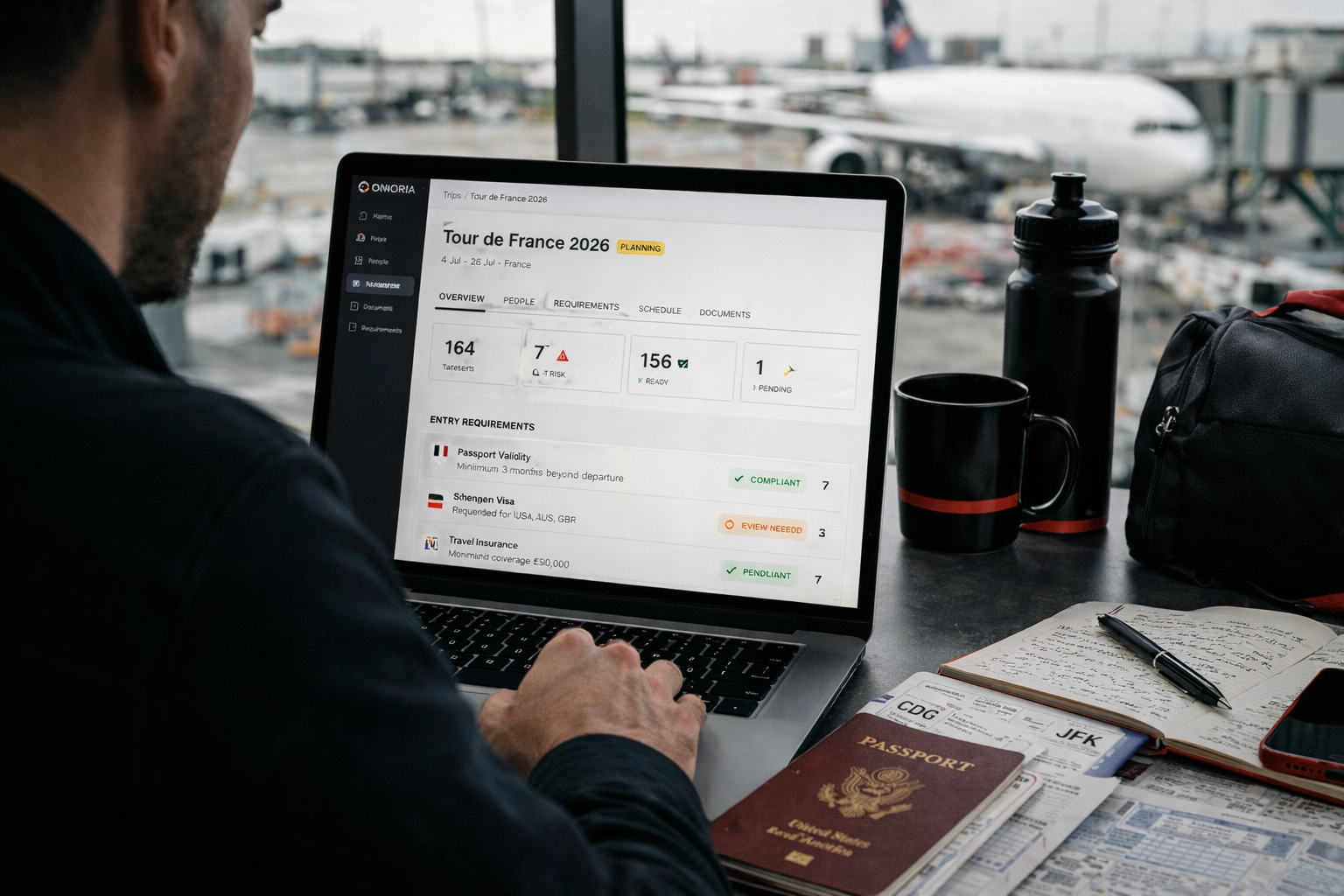
Instead of researching requirements every time a new trip is planned, teams benefit from a system that connects destination rules with the people who are actually traveling. This means linking country-specific requirements to nationalities, documents, and upcoming trips or events.
When a destination is introduced into the system, relevant requirements can be surfaced immediately based on known patterns. Passport validity rules, visa needs by nationality, and common documentation requirements are pre-associated with that country.
This does not replace verification. It changes where the work starts.
Reducing errors through pre-populated requirements
One of the main sources of error in travel operations is rebuilding requirements from scratch for each trip.
When teams rely entirely on manual setup, they are forced to remember what applied previously and reconfigure it each time. This is where omissions happen. A requirement that existed for a previous trip may not be re-entered. A new rule may not be identified early enough.
Pre-populating requirements shifts the process from creation to validation.
Instead of asking "what are the requirements?", teams start with a structured set of likely requirements and confirm what applies. This is faster, more consistent, and significantly less prone to error, especially in environments with frequent travel cycles such as professional sports or international production teams.
Keeping pace with changing regulations
A common concern with any system is accuracy over time. Entry requirements evolve. Visa policies change. Health and administrative rules are updated regularly.
A static list of requirements quickly becomes unreliable.
The most effective approach combines a maintained baseline of common rules with the flexibility for teams to adjust based on real-world updates and their own experience. The system acts as a continuously improving reference point, not a fixed source of truth.
This balance is critical. Teams need both structure and control.
Built for real-world travel operations
Onoria is designed to make international travel requirements manageable at scale. It connects personnel, their documents, and country-specific entry rules to the trips and events that matter, allowing teams to see what is required for each destination without rebuilding the process every time.
Instead of starting from a blank page, operations teams begin with a structured understanding of requirements and refine it based on their specific context. This reduces manual work, improves consistency, and makes travel readiness easier to manage across countries.
For organizations operating internationally, the goal is not to eliminate complexity. It is to make it visible, structured, and actionable.
See who's ready to travel — before every trip.
Add your travellers and trips, and Onoria flags expiring passports, missing visas, and entry requirements weeks ahead — not at the airport.